

Well, January is a little over half gone. The weather has been interesting with a few nice days, really cold days and snow showers most of the time. Luckily the accumulation has been mild. We have been down and out with a cold most of the time since the beginning of the month. It just does not seem to want to go away. There certainly was no interest in going out and dealing with snow removal.
We still have no new and exciting birds showing up at the feeder. There are lots and lots of Blue Jays and Mourning Doves. We have not seen the Robin lately.
Since I haven’t been feeling well, I have not had too much contact with anyone for news. I did speak to Judy Bishop, who lives in Yarmouth, and she told me that she had attended a birthday party for a little four-year-old relative. The party was quite exciting since Mr. Drew and His Animals Too from Poland, ME were there to entertain the children. He brought several species for the children to look at and learn about. His visit was not only interesting but educational. The children (and adults) enjoyed the presentation and the chance to get up close to some of these animals that one would never get a chance to see. The location in Poland evidently is a great place to visit.
Gilead Historical Society
Historical Note: Excerpt from the GHS publication, {The Patent, by Howard C. Reiche, Jr. and Hugh G. Chapman, Fall 2005}-Harvesting Ice on the Androscoggin
“Back in the 1800’s, keeping the family warm and fed kept a Gilead farmer pretty busy. Most of what fed them was raised on his farm, and a lot of it was perishable: milk, butter, meat, etc. The vegetables and fruits could be kept a while in the cool “root cellar” under the house. Much of this food was preserved or dried in order to keep it longer. There was no handy refrigerator, or deep freeze.
The warm months had an impact on what was on the table. However, this could be changed if ice was available to the farmer. Most of the farmers had an icehouse on the farm. Very few of these have survived because they weren’t strongly built in the first place.
Usually, they were built with upright poles sheathed with rough boards. Often there were two walls about a foot apart. This space was filled with sawdust or hay for insulation. The roof was just enough to keep out the rain. As the layers of cakes of ice were built up in the winter, they were covered with sawdust or hay along the edges and between the layers, again, for insulation. It was amazing how well this kept the ice through the summer. Digging a block of ice out of the pile in the summer was always a pleasant experience.
Ice was “cut” on the Androscoggin River, millponds and on small brooks dammed for that purpose. For instance, Ingall’s Brook had a small, dammed area, which filled three icehouses. Probably, these were built by Tallyrand Lary and were used later by O. B. Brown.
Cutting on the river must have been difficult. It had to be on an eddy where the thick ice could form uniformly. Also, it had to be easily available to the oxen and horses that were used to scrape away the snow, score the ice into cakes and haul them to the farmer’s icehouse. An open winter, or one with repeated “ice-outs” must have been a serious hardship to the farmer. Also, if he sold ice to his neighbors, he had lost a cash crop. In reviewing old Gilead town records, we found no mention of people selling ice. However, the large number of Gilead boarding houses with vacationers and mill workers must have used a lot of it.
Imagine how things changed when the first refrigerator came through that farmhouse.”
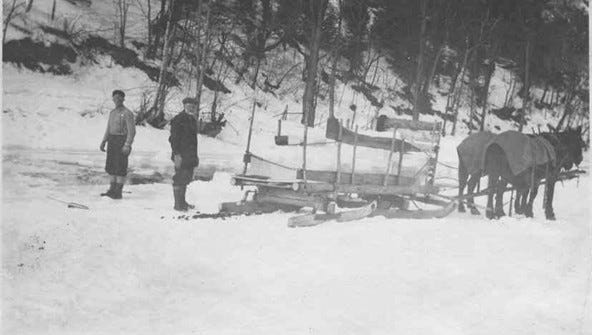
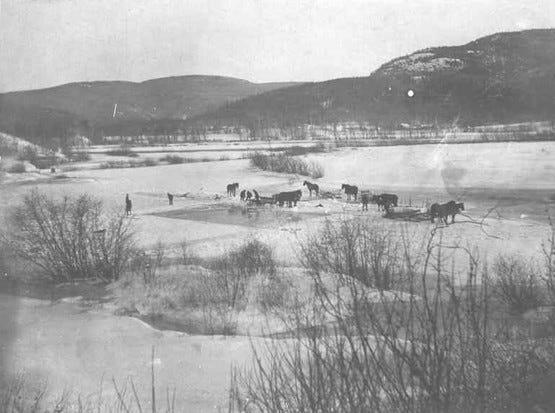
(Photos from the collection of Hugh & Linsley Chapman--originally from the Emeline Heath collection)
Got any news? Email chapmal@hotmail.com